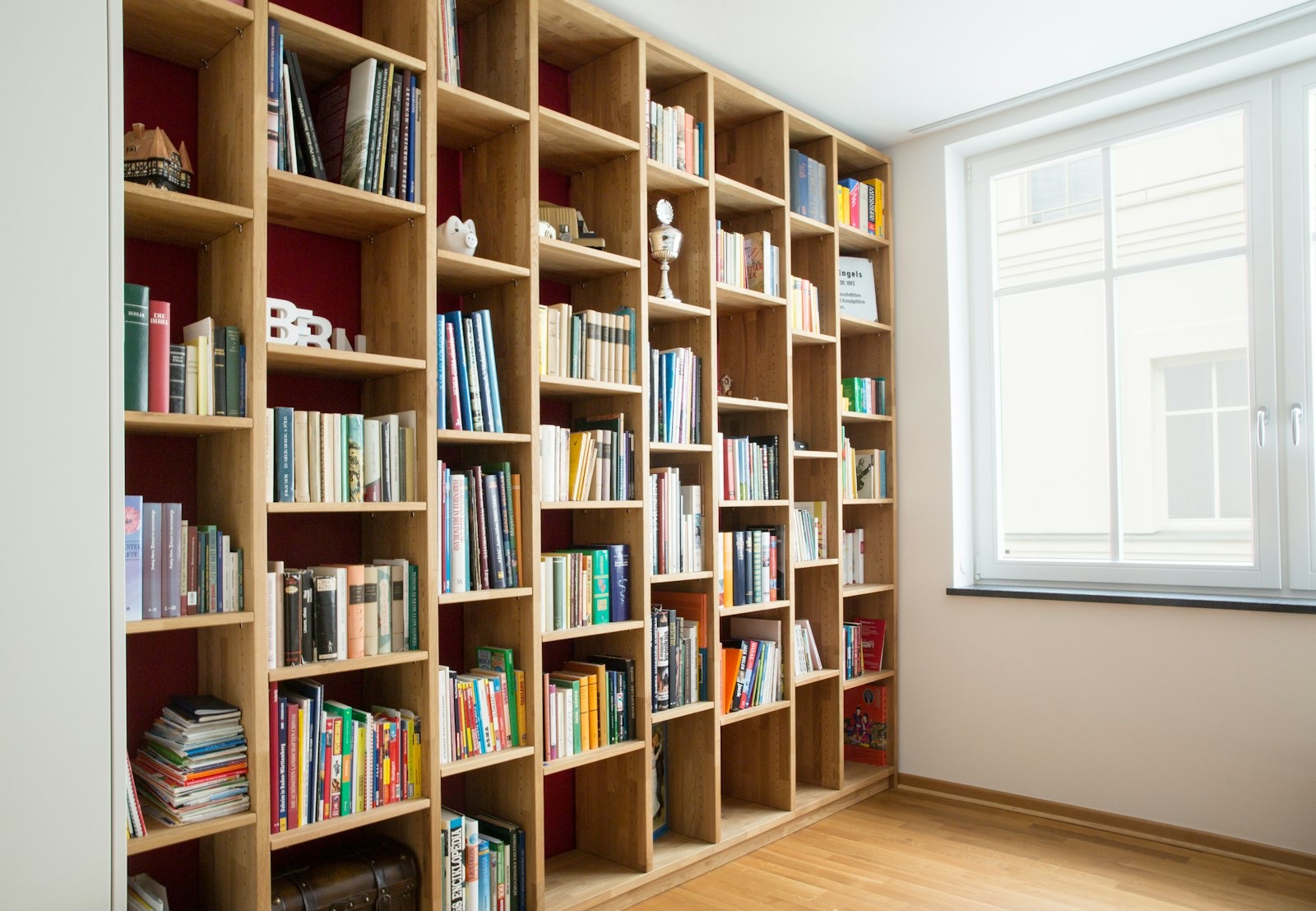
Books are one of the densest things people put on furniture. A three-foot shelf of hardbacks weighs seventy to eighty pounds, which is why so many bookcases develop a permanent smile across the middle shelf.
Sagging is not bad luck. It is a predictable consequence of shelf span, thickness and material, and it can be avoided at the point of purchase.
Here is how to size shelves for what you actually own, and how to buy a bookcase that stays straight.
Depth and Height: Size to Your Books
| What you shelve | Shelf depth needed | Clear height needed |
|---|---|---|
| Paperbacks | 5″ | 8″ |
| Standard hardcovers | 8″ | 10½″ |
| Coffee-table and art books | 11″ | 15″ |
| Box files and folders | 12″ | 13″ |
| Display objects and baskets | 12″+ | Varies |
Standard bookcases run 10 to 12 inches deep, which handles everything except large-format art books. Deeper is not automatically better — a 16-inch shelf holding paperbacks just collects dust at the back.
Adjustable shelves matter more than any other feature here. A fixed-shelf bookcase locked at paperback spacing will never take a folder or an art book.

Span and Sag: The Part Nobody Checks
The distance between vertical supports is what determines whether a shelf bows. Material matters just as much as thickness.
| Shelf material (¾″ thick) | Practical span for books | Behaviour under load |
|---|---|---|
| Solid hardwood | 36″ | Stiffest; recovers when unloaded |
| Plywood | 32–36″ | Very good; stable across humidity |
| MDF | 24–30″ | Flat and smooth, but flexes sooner |
| Particleboard | 24″ or less | Creeps — the sag becomes permanent |
The word that matters is creep. Solid wood and plywood flex under load and spring back; particleboard gradually accepts the curve and keeps it, which is why cheap bookcases end up permanently bowed.
As a rule of thumb, the eye notices about 1/32 of an inch of deflection per foot of span. A loaded three-foot shelf sagging more than roughly 3/32 of an inch will look wrong even if it is structurally fine.
How to beat sag without spending more
- Choose narrower units — two 30-inch bookcases outperform one 60-inch unit
- Look for shelves an inch or more thick, or with a front edge banding that stiffens them
- Put the heaviest books on the bottom shelves, where spans are usually shortest
- A centre support post turns one long shelf into two short spans
- Turn a bowed shelf over — it will straighten under load in the opposite direction

Standard Dimensions and Ceiling Fit
| Dimension | Typical range | Guidance |
|---|---|---|
| Width | 24–48″ | Under 36″ for book-heavy loads |
| Depth | 10–12″ | 12″ if you shelve files or large books |
| Height | 36–84″ | Above 72″, anchor it without exception |
| Highest usable shelf | 72–78″ | Beyond this you need a step to reach |
| Gap to ceiling | 6–12″ | Less looks cramped; more looks unfinished |
A tall narrow bookcase reads as elegant; a tall wide one reads as a wall. In a small room, two narrow units flanking a window usually work better than one large unit dominating a wall.
Which Style Suits the Job
| Style | Storage capacity | Best for | Watch for |
|---|---|---|---|
| Standard open bookcase | High | Genuine book collections | Everything is on display |
| Ladder / leaning | Low | Display, plants, small rooms | Shallow top shelves; must be wall-fixed |
| Cube or grid unit | Medium | Baskets, files, kids’ rooms | Fixed spacing limits tall items |
| Corner bookcase | Medium | Reclaiming dead corners | Shelves narrow toward the back |
| Bookcase with lower doors | High | Rooms needing some clutter hidden | Costs more for the same volume |
| Wall-mounted shelving | Variable | Small rooms; zero floor footprint | Fixings must hit studs |
Ladder shelves photograph beautifully and hold remarkably little. They are a display piece rather than storage, and their shallow upper shelves will not take hardcovers at all.
For a mixed room, the most practical answer is usually a unit with open shelving above and closed doors below — books on show, everything else out of sight.
Anchoring Is Not Optional
A loaded bookcase is top-heavy, and books are exactly the thing children climb shelves to reach.
- Fix the supplied anti-tip bracket into a wall stud, not into drywall alone.
- Load the bottom shelves first and heaviest.
- Keep the top shelf light — and keep tempting objects off it entirely.
- Check the back panel is fixed all round; a loose back lets the case rack sideways.
- Re-check fixings annually.
If the bookcase is going into a child’s room, our kids bedroom furniture guide covers anchoring and reachable storage heights in more detail.
A Note on Engineered Wood
Most affordable shelving is particleboard or MDF with a veneer or laminate face, and that is not automatically a problem — engineered panels are flat, stable and inexpensive.
What is worth knowing is that composite wood products sold in the US must meet formaldehyde emission limits. Those limits originated with the California Air Resources Board and were subsequently adopted nationally, so compliant panels are the norm rather than the exception.
Practically: buy from established retailers, and give any new engineered-wood furniture a few days of ventilation before filling a small room with it.
Frequently Asked Questions
How deep should a bookshelf be?
Ten to twelve inches suits most collections. Paperbacks need only five inches, standard hardcovers eight, and large art books eleven — so 12 inches covers almost everything.
Why do bookshelves sag?
Because the span between supports is too long for the material. Particleboard is the worst offender because it creeps — the bend becomes permanent rather than springing back when unloaded.
What is the maximum shelf span for books?
Around 36 inches for three-quarter-inch solid wood or plywood, and 24 inches or less for particleboard. Narrower units, thicker shelves or a centre support all solve the problem.
How tall should a bookcase be?
Keep the highest usable shelf between 72 and 78 inches so you can reach it, and leave 6 to 12 inches between the top of the unit and the ceiling for visual balance.
Do bookcases need to be anchored to the wall?
Yes, particularly anything over about 72 inches or in a home with children. A loaded bookcase is top-heavy, and the anti-tip bracket should go into a stud rather than drywall alone.

Check the Shelf, Not Just the Look
Press down on the middle of an empty display shelf. If it gives noticeably under hand pressure, it will bow under books.
Our home office furniture range in Newport News includes bookcases and shelving in a range of widths, and you are welcome to test the shelves by hand before deciding.
Pairing shelving with a work surface? Our office credenza guide covers the storage-plus-desk combinations, and the accent cabinet guide covers lower display pieces for a living room.
Browse living room furniture and accents and lamps to finish a reading corner, or kids furniture for a child’s room.
Check clearance and specials, spread the cost with no-credit furniture financing, and see our delivery guide — tall bookcases are long and unwieldy on stairs. Questions on span or load? Ask our Newport News team.